If you see someone testing your BMW with an incandescent test light… walk away.
A test tool can change the circuit you are trying to assess. BMW electrical diagnostics starts with understanding the architecture and choosing how to measure it.
Eight original slides in Spanish, with an English technical explanation below. Swipe, use the buttons, or press ← and → while the carousel has focus.
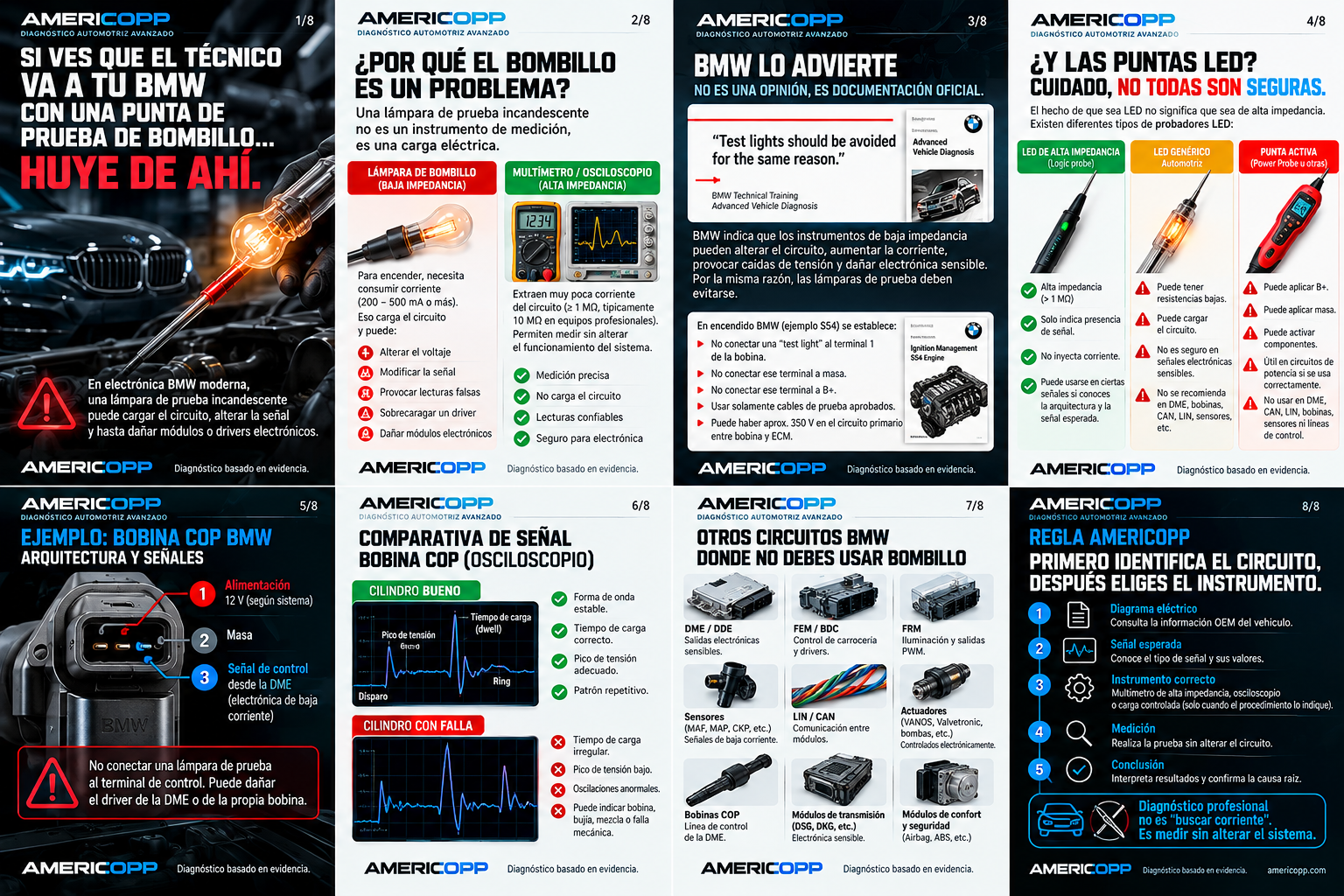
Identify the circuit first. Then choose the instrument.
Professional diagnostics is not about finding power. It is about measuring without disturbing the system.
Why an incandescent test light can change the signal
An incandescent lamp draws current to illuminate. Connecting it adds a load that can shift voltage, distort a signal or overload an electronic output. BMW's Advanced Vehicle Diagnosis explains the effect of low-impedance instruments and advises against test lights for this reason. A glowing bulb does not prove that an electronic signal is correct.
An LED indicator is not a safety specification
A high-impedance LED probe draws little current to indicate a state. Its input specifications, voltage range and compatibility with the expected signal still need checking. A generic LED tester may load the circuit; the LED describes its indicator, not its electrical behavior.
An active probe or Power Probe has a different role. Some models can supply B+ or ground to activate components. Measuring and applying power are separate functions. Do not inject power or ground into signal, control or communication lines. An instrument's internal protection does not guarantee protection of the connected electronics.
Identify the circuit before touching the pin
For BMW DME/DDE diagnostics, FEM/BDC, FRM, sensors, CAN/LIN networks and COP ignition coils, use the vehicle's OEM diagram to distinguish power, ground, signal, communication and power-stage outputs. Different pins on the same module require different tests. A coil control line must not be treated as a 12 V supply. Our CAN and LIN diagnostic guides explain why network architecture matters.
Match the instrument to the diagnostic question
- High-impedance multimeter: measure voltage with the correct input, function and range. An unloaded voltage reading does not prove that a feed can carry its operating load.
- Oscilloscope: assess waveform shape and timing using suitable probes, attenuation and reference connections. Ignition testing requires accessories and procedures rated for that architecture and its voltages.
- Voltage-drop testing: check power feeds, grounds and connections while current flows under the specified operating conditions. Testing under load can reveal resistance that an unloaded reading misses.
- Controlled load: apply only the load and connection method permitted by the vehicle procedure. A power-circuit test must not be transferred to a sensor, signal or network pin.
Reading the artwork: the bulb-current range is illustrative and varies with the lamp and supply voltage. The coil pinout and waveform comparison are examples, not universal specifications or measurements from a documented repair. BMW's terminal 1 warning and approximately 350 V figure refer to MS S54 ignition; that primary circuit must not be confused with a logic-level input on a coil with integrated electronics. Always confirm the actual vehicle diagram and test procedure.
Our approach to BMW electrical troubleshooting in Arequipa follows the same sequence: identify, measure and verify the cause before replacing components.
Technical sources
- BMW Technical Training — Advanced Vehicle Diagnosis, p. 104 (DVOM) — Archived copy of BMW training material.
- BMW Technical Training — MS S54 Ignition Management, p. 57 (ST041) — Archived copy of BMW training material.
- Niterra / NGK Pro Training — Modern Ignition Technology — ASE's published program: smart coils and waveform analysis.
- Fluke Automotive Diagnostics — Diagnosing voltage drop: electrical automotive troubleshooting — Input impedance and testing under load.
- Power Probe — PP3 Circuit Tester — Measurement and battery-voltage/ground activation functions.