BMW F20 N13: VANOS faults traced to a poor oil pressure sensor connection
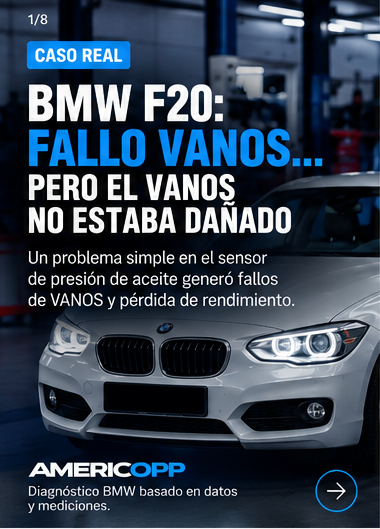
This 2013 BMW 116i F20 had exhaust VANOS control faults and reduced performance. Although the codes pointed toward VANOS, diagnosis traced the primary cause to a poor electrical connection at the oil pressure sensor.
Reported symptoms
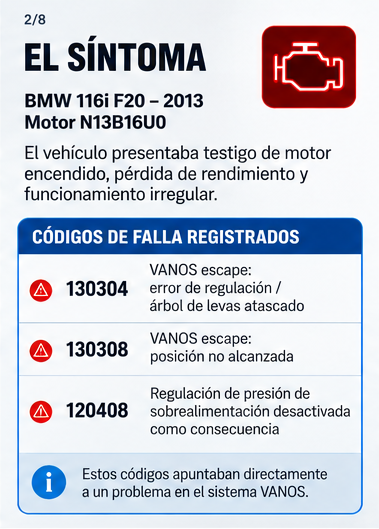
- Check Engine / engine warning lamp and recorded DTCs.
- Reduced or limited performance.
- Exhaust VANOS control faults.
- A consequential boost control fault.
No mechanical failure of the VANOS mechanism was confirmed.
Recorded fault codes
VANOS exhaust: control fault / camshaft jammed
The DME detected an abnormal response during exhaust camshaft control. “Jammed” is part of the fault description; the wording alone does not prove a mechanical seizure.
VANOS exhaust: control fault / position not reached
The actual position did not reach the commanded position under the system’s monitoring conditions. The code calls for investigation of camshaft regulation and its operating conditions.
Boost pressure control: shutdown as a consequential reaction
In this case it was interpreted as a secondary fault associated with the operating limitation. It does not, by itself, establish a failed turbocharger.
Interpreting BMW fault codes (Spanish guide) requires live data, the conditions in which each fault appeared and circuit checks.
Initial hypotheses: what needed consideration
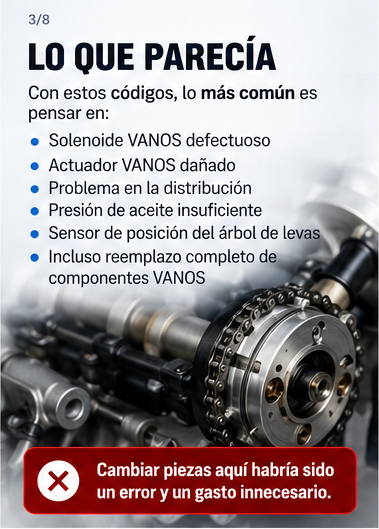
These codes initially direct attention to the VANOS solenoid, VANOS actuator or camshaft adjuster, mechanical timing, oil pressure and supply, the camshaft position sensor, and connectors and wiring. These are diagnostic hypotheses, not a list of replaced parts.
VANOS is an electrohydraulic system
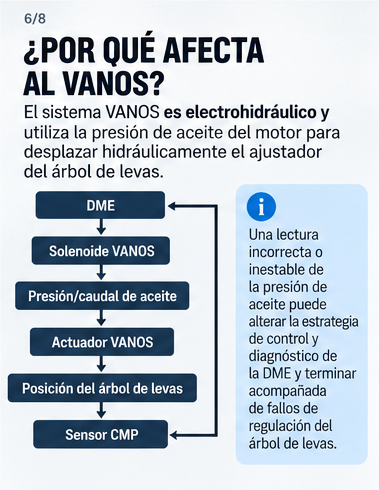
The DME electrically commands regulation, while engine oil hydraulically moves the camshaft adjuster. The response is assessed by comparing commanded position with actual position and considering engine operating conditions.
The oil pressure sensor supplies information to engine management; it does not directly control VANOS. A genuine hydraulic pressure problem must therefore be distinguished from an implausible electrical signal. Oil supply, sensors, connectors and wiring all need consideration before concluding that the mechanism is damaged.
See our VANOS diagnostic guide (Spanish). This case does not establish the exact internal DME strategy or quantify a physical loss of oil pressure.
Diagnosis: from fault codes to the root cause
- Read the complete fault memory.
- Review live data.
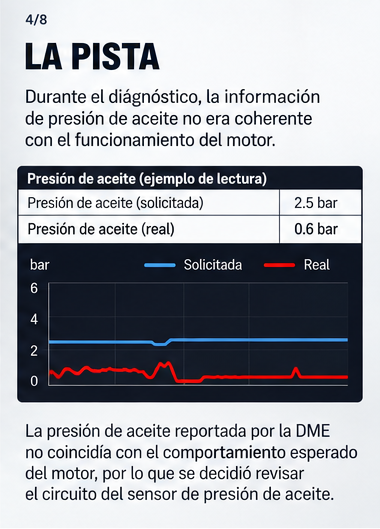
- Evaluate oil pressure behavior and the plausibility of the available information.
- Inspect the oil pressure sensor.
- Check its electrical connection.
- Identify the poor connection.
- Repair the connection.
- Clear the DTCs.
- Perform a new functional check of the vehicle.
- Confirm that the problem has been resolved.
Confirmed root cause
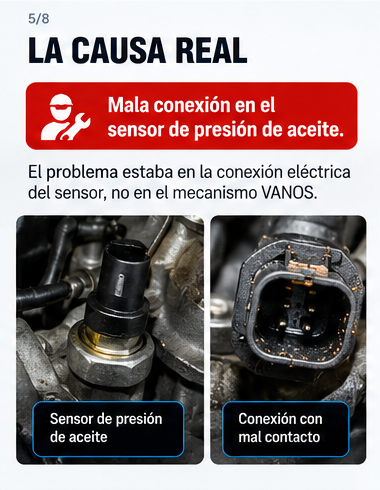
A poor electrical connection at the oil pressure sensor.
The defect was in the sensor connection / signal path, rather than confirmed damage to the VANOS mechanism. The response after repairing the connection and repeating the check confirmed the resolution of this case.
Repair and outcome
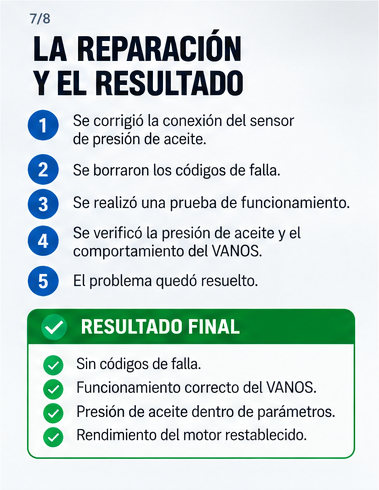
The oil pressure sensor connection was repaired, the fault codes were cleared and the vehicle was checked again. VANOS operation returned to normal and the problem did not recur during the subsequent check.
The published validation is limited to that follow-up check. No undocumented test mileage, pressure readings, temperatures or extended follow-up period are attributed to this vehicle.
Technical diagnostic information
Vehicle: 2013 BMW 116i F20, N13 / N13B16U0. Recorded DTCs: 130304, 130308 and 120408. Confirmed intervention: repair of the oil pressure sensor connection. The available case narrative does not include the VIN, test date and time, scanner model or version, Current / History / Pending status, freeze-frame data, system voltage or numerical oil pressure records; these details are not reconstructed.
Eight-panel case study
The supplied Spanish-language artwork is preserved below. Each panel has an English explanation, and the complete case narrative is available in English on this page.
Select 1–8. Keyboard: Tab into the selector, then use the arrow keys to change panels.
Read the English explanation of all eight panels
1 · The case
A 2013 BMW 116i F20 with the N13B16U0 engine. The confirmed cause was a poor oil pressure sensor connection. Mechanical VANOS damage was not confirmed.
2 · Symptoms and fault codes
The engine warning lamp, reduced or limited performance and faults 130304, 130308 and 120408 were reported. The irregular running mentioned in the graphic is not added as a confirmed symptom in this case narrative.
3 · Initial hypotheses
The solenoid, adjuster, mechanical timing, oil supply and camshaft position signal are diagnostic considerations. The graphic does not establish that any of these components were replaced.
4 · The diagnostic clue
Comparing pressure information with engine behavior directs attention to the sensor circuit. The 2.5 bar and 0.6 bar values and chart are illustrative examples, not recorded data from this BMW.
5 · The root cause
A poor electrical connection at the oil pressure sensor. The sensor and connector images are educational illustrations, not certified photographs documenting this vehicle.
6 · How VANOS operates
The DME commands electrohydraulic regulation; engine oil moves the camshaft adjuster and position sensors provide feedback. The oil pressure sensor supplies information; it does not directly actuate VANOS. The exact internal DME strategy was not documented in this case.
7 · Repair and verification
The connection was repaired, the faults were cleared and the vehicle was checked again. VANOS operation returned to normal and the problem did not recur during that check. Numerical oil pressure readings were not documented.
8 · The diagnostic lesson
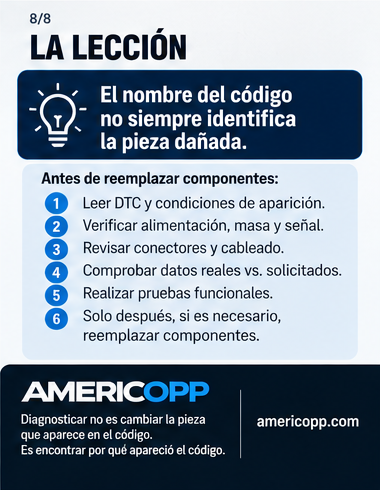
A DTC identifies a detected anomaly, not necessarily a defective part. Verify power supply, ground, signal, connectors, wiring and data plausibility before replacing components.
The technical lesson
A fault code identifies the system that detected an anomaly, but it does not necessarily identify the defective part.
Before replacing components, verify power supply, ground, signal, connectors, wiring and live data.
This repair describes a confirmed cause in one specific vehicle. The same DTCs on another BMW require their own diagnosis: repairing this connector is not a universal remedy for every VANOS fault.
Americopp provides specialist BMW diagnostics in Arequipa, using data and functional checks to identify the root cause.
Discuss the diagnosis with Americopp in Arequipa.