A symptom looks straightforward. Once diagnosis or programming begins, new variables can change the time and scope of the repair.
In automotive electronics, we often know when diagnosis starts… but not when it will end.
One case per slide. Swipe to advance or select an image to enlarge it.
1/7 · BMW SIB 09 01 18IRAP: a VANOS repair led to recovery of another moduleView BMW document (PDF)2/7 · BMW SIB 61 13 05Discharged battery: diagnosis does not end with replacementView BMW document (PDF)3/7 · BMW SIB 24 03 19No EGS communication: the cause was under the dashboardView BMW document (PDF)4/7 · BMW SIB 01 20 16FRM: a fault can appear during another repairView BMW document (PDF)5/7 · BMW SIB 65 08 25Intermittent black screen: check wiring tensionView BMW document (PDF)6/7 · BMW SIB 65 14 18Audio failure: repair the water leak tooView BMW document (PDF)7/7 · BMW SIB 11 06 16Valvetronic: oil can reach the DME connectorView BMW document (PDF)
The initial suspicion guides the investigation. Measurements and procedures determine how far it must continue. A repair may require additional checks, module recovery or wiring work when new evidence emerges.
These cases were published by BMW and explained by Americopp with educational illustrations. The images help explain the process. To identify components, connectors and procedures, consult the document applicable to the vehicle.
The seven cases and their BMW sources
Manufacturer bulletins available in the public NHTSA archive. Each case retains its application limits and the date of the version consulted.
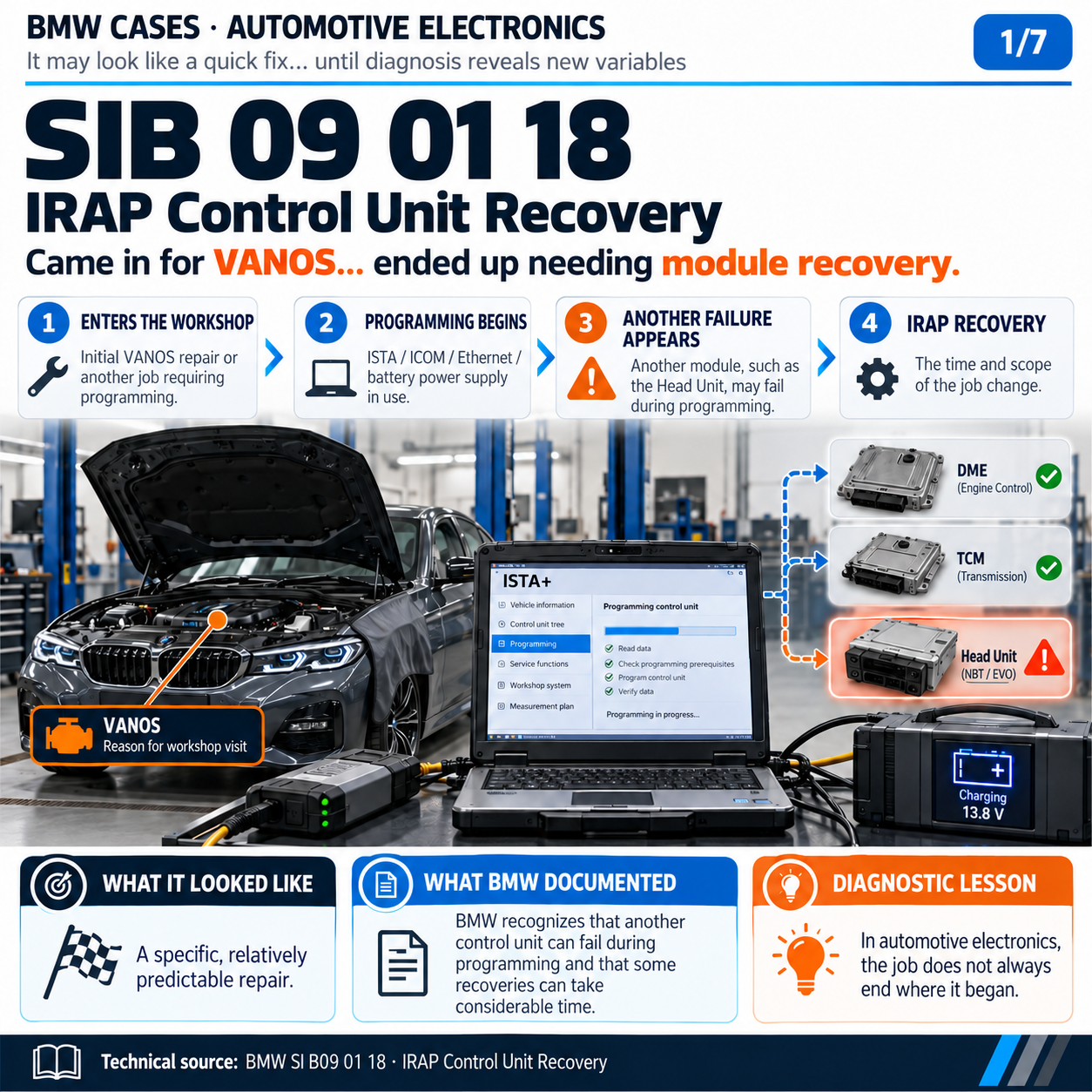
1. IRAP: a VANOS repair led to recovery of another module
BMW SIB 09 01 18 · Version consulted: October 23, 2019
BMW describes a VANOS repair that requires programming. During the process, the head unit may stop working. The bulletin identifies potential issues with hardware, the workshop network, ICOM/Ethernet, the battery charger, ISTA or vehicle communication. The BMW service network must open a TSARA case and attempt IRAP recovery. If recovery fails, the procedure provides for replacement authorization.
Why the scope changes: The scope changes: recovering another control unit is added to the original repair. BMW warns that recovery may take considerable time. IRAP is a BMW service-network procedure; Americopp is not offering it as a recovery service.
Application: The programming example described by BMW; a procedure for its service network.
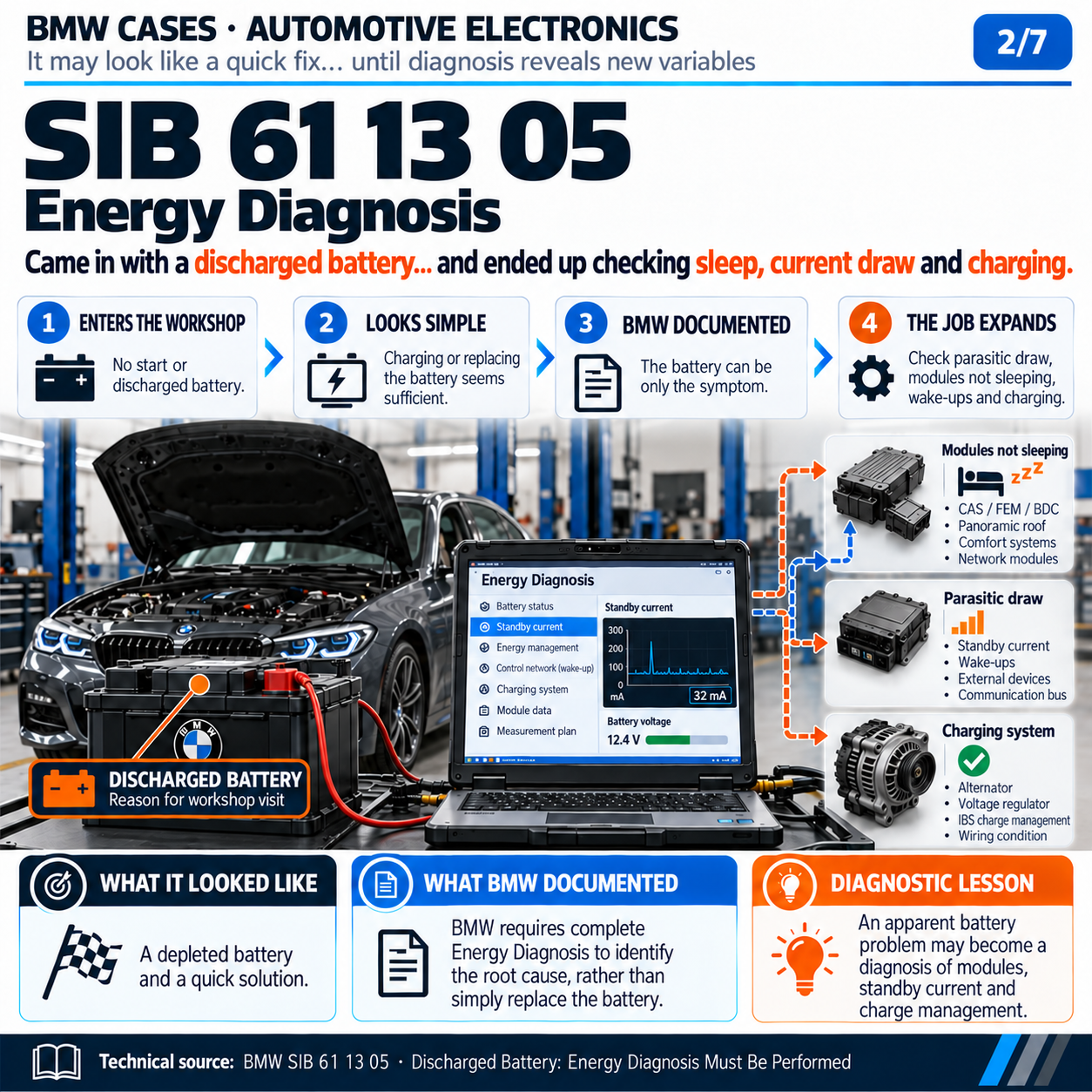
2. Discharged battery: diagnosis does not end with replacement
BMW SIB 61 13 05 · Version consulted: April 14, 2021
BMW requires a complete Energy Diagnosis to investigate battery discharge. The battery may be the consequence of another fault. Results can lead to checks of the alternator, standby current draw, prevented sleep, repeated wake-ups or usage patterns. The bulletin requires diagnosis before registering a new battery, because registration deletes the energy history.
Why the scope changes: What looked like a replacement may require monitoring the parked vehicle and identifying what wakes it up or draws current. The time required depends on the findings.
Application: Vehicles produced from March 2004, except I-Bus vehicles; check the conditions in the bulletin.
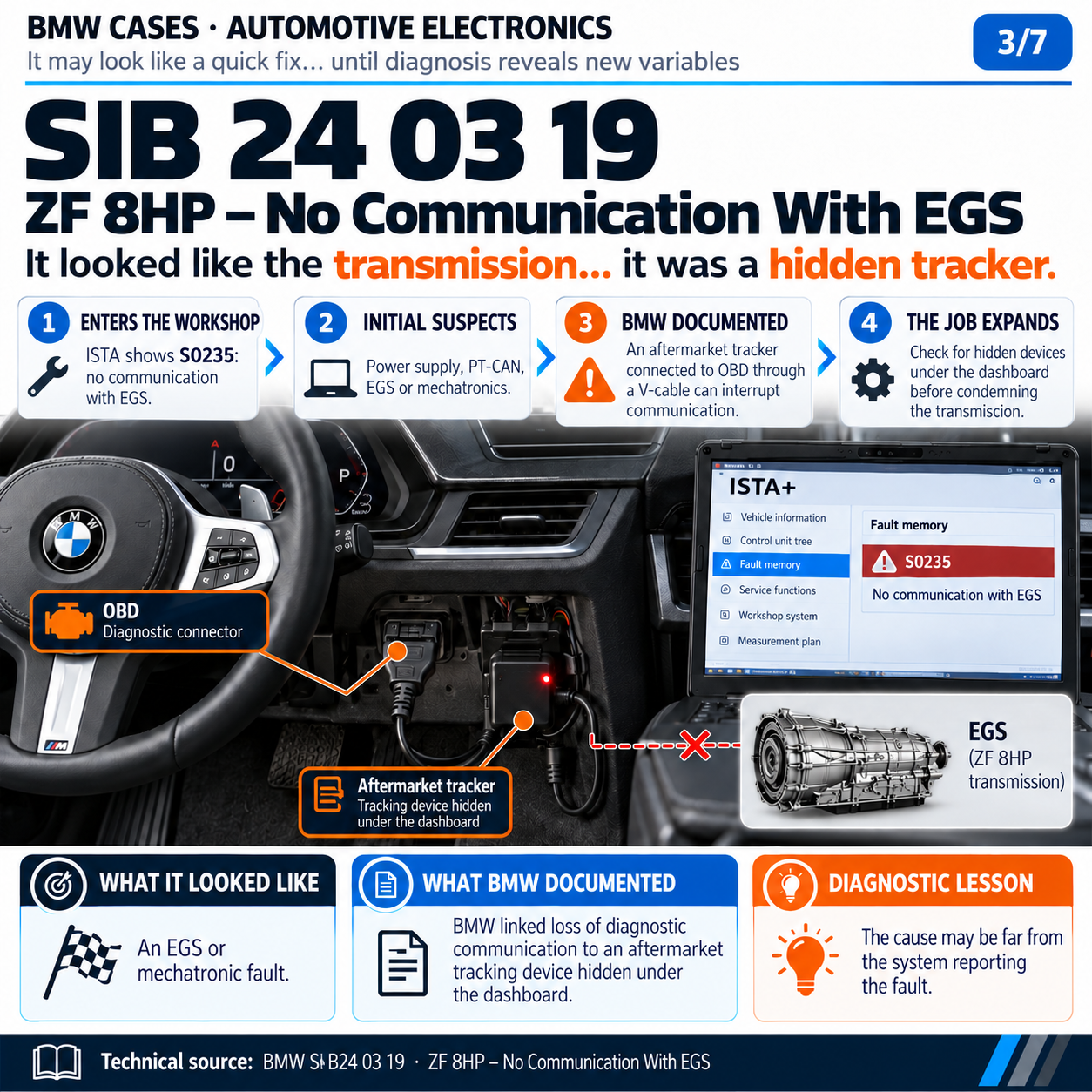
3. No EGS communication: the cause was under the dashboard
BMW SIB 24 03 19 · Version consulted: August 27, 2019
ISTA displays S0235: no communication with the electronic transmission control unit (EGS). The test plan may lead to power supply, PT-CAN and mechatronics checks. BMW documents an aftermarket tracker connected through an OBD adapter, hidden under the dashboard, that can interrupt diagnostic communication without causing driving complaints. It instructs technicians to look for and disconnect the device before continuing.
Why the scope changes: A loss of communication alone does not prove the transmission is defective. The investigation may extend to aftermarket installations.
Application: Vehicles with a ZF 8HP transmission covered by the bulletin.
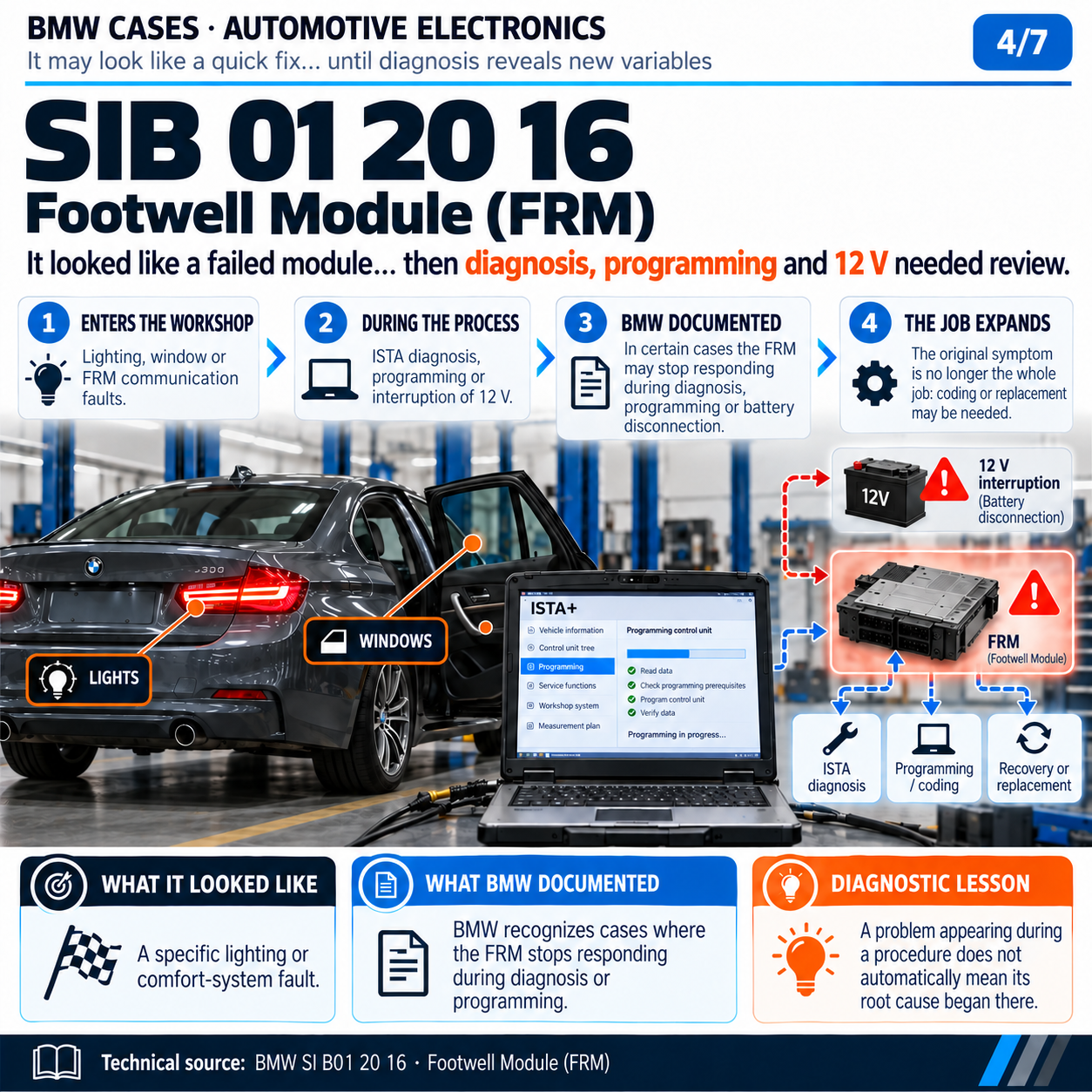
BMW SIB 01 20 16 · Version consulted: March 13, 2025
BMW recognizes failures of the footwell module (FRM), which controls lighting and body functions, during ISTA diagnosis, software updates or interruption of the 12 V supply. The document identifies incompatibility between certain software and hardware versions. It also distinguishes modules that had already failed before the intervention. Applicable cases require FRM replacement and the associated work.
Why the scope changes: Timing alone does not establish that the diagnostic tool caused damage. An intervention can reveal another condition and expand the repair. This SIB is a BMW North America warranty extension, not a recall; its coverage does not automatically apply in Peru.
Application: Selected E70/E71/E72/E82/E84/E88/E89/E90/E91/E92/E93 vehicles; eligibility is determined by VIN.
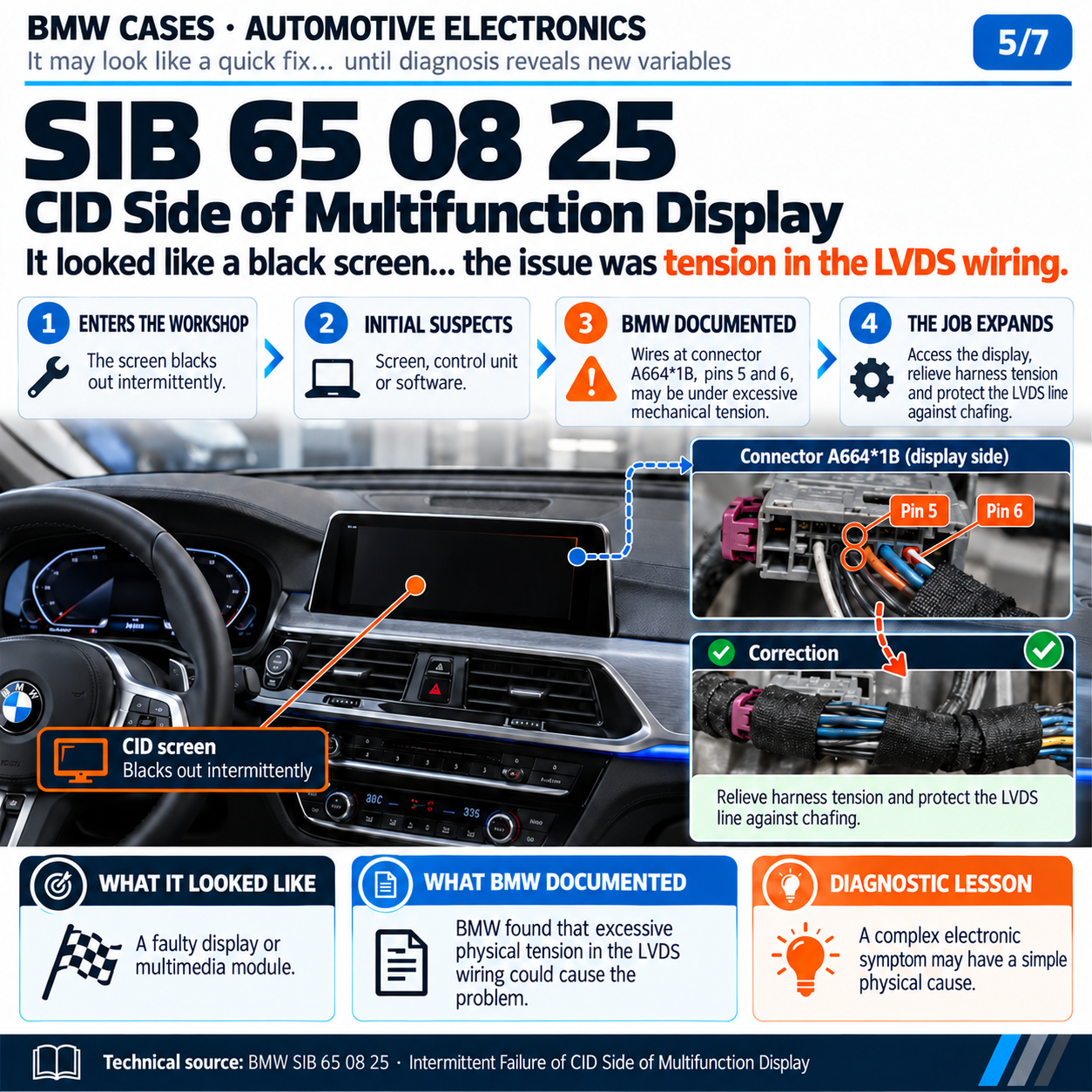
5. Intermittent black screen: check wiring tension
BMW SIB 65 08 25 · Version consulted: April 28, 2025
The central information display (CID) may intermittently go black. BMW identifies excessive wiring tension at connector A664*1B on the LVDS data line. The procedure calls for accessing and checking the wires at pins 5 and 6. If they are under tension, release the wrapping and protect the area against chafing. If that condition is absent, continue normal diagnosis.
Why the scope changes: An intermittent symptom may require checking the physical condition of the wiring before condemning the display or a control unit. Reproducing the fault and validating the result are part of the work.
Application: The G/U models listed in the bulletin; multifunction display connector A664*1B.
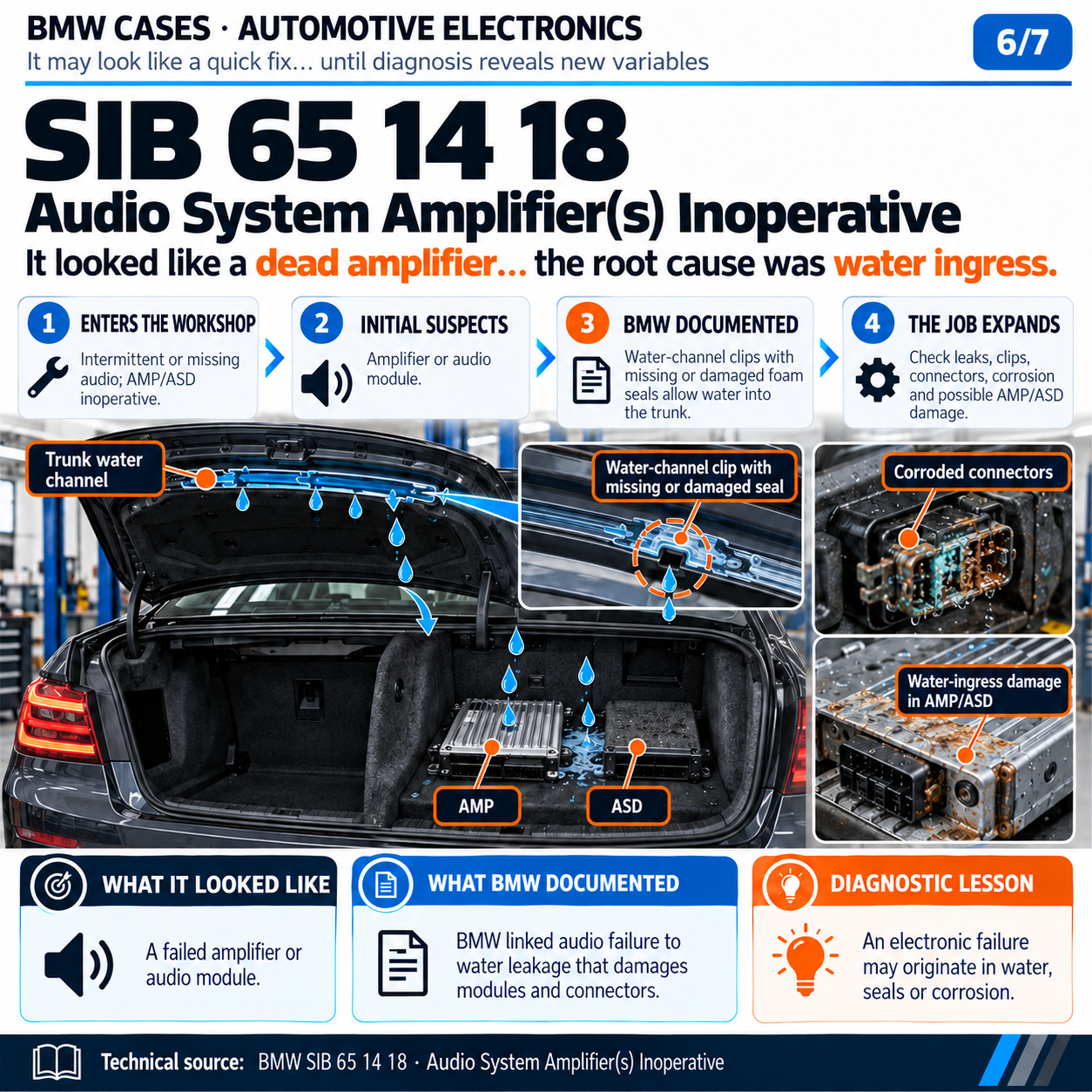
BMW SIB 65 14 18 · Version consulted: January 2019
BMW links audio amplifier (AMP) or Active Sound Design (ASD) failures to missing or damaged foam seals on trunk water-channel clips. The procedure includes inspecting modules, connectors and pins, correcting affected clips or channels, and replacing damaged equipment where required. It also calls for checking previous repairs and performing a water-leak test.
Why the scope changes: Replacing the module does not complete the repair if water continues to enter. Diagnosis expands from the audio system to sealing, corrosion and other potential trunk damage.
Application: BMW G12 (7 Series) covered by the consulted bulletin.
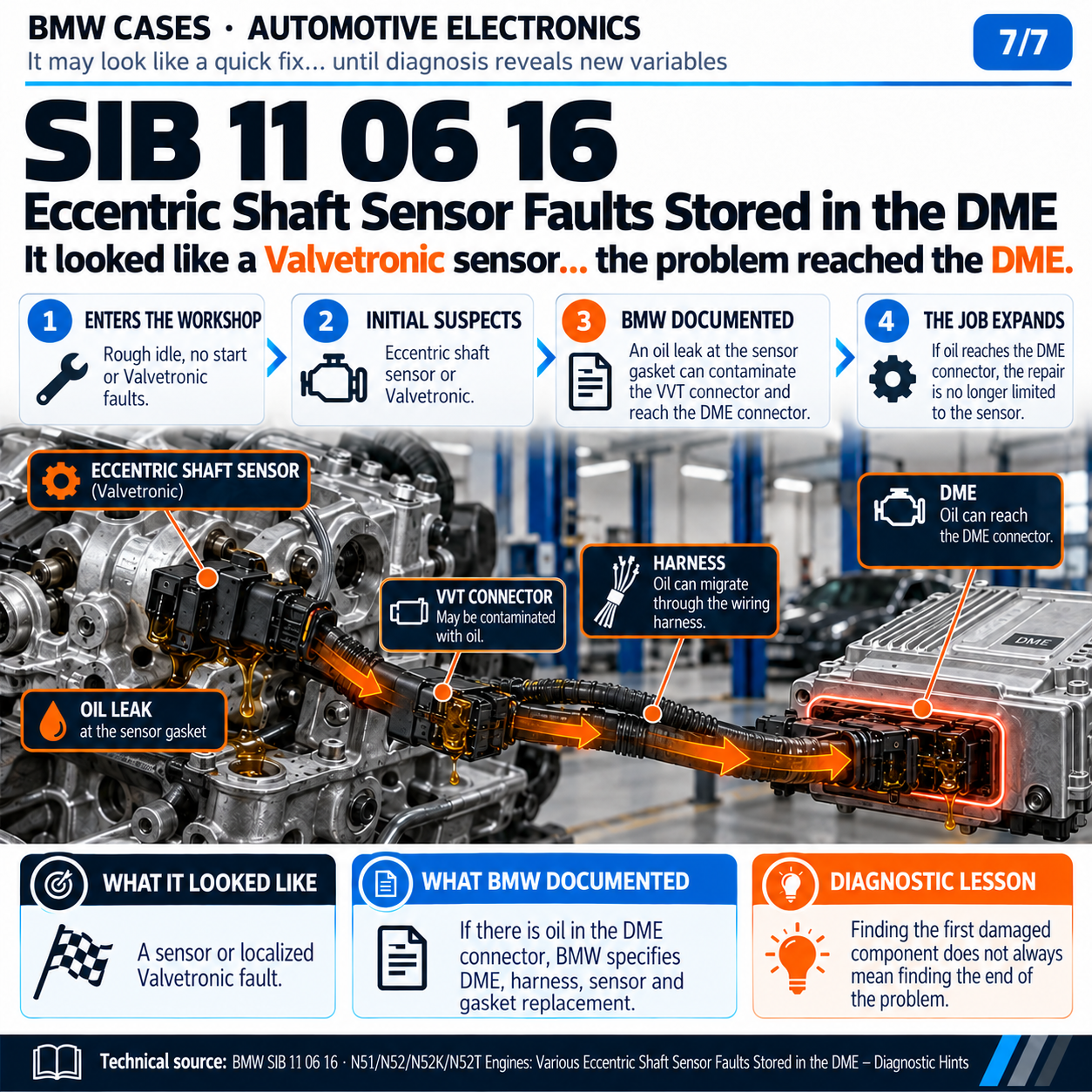
For rough running, a no-start condition or eccentric-shaft sensor faults, BMW instructs technicians to inspect VVT connector X60253 for oil. If contamination is present, the investigation continues to DME connector X60007 and the wiring harness. If oil is found there, the procedure calls for replacing the DME, harness, sensor and gasket; otherwise, the scope differs.
Why the scope changes: Finding the first affected component does not establish where the damage ends. This case documents oil contamination; it does not prove that a burned-out Valvetronic motor necessarily destroys the DME on an N55.
Application: N51, N52, N52K and N52T engines. This bulletin does not apply to the N55.
The practical lesson is to work in stages: confirm the symptom, measure, identify the cause, define the repair and validate it. When a new finding emerges, communicate it to the customer and update the scope and estimate.
Finding an affected component does not always mean reaching the end of the problem.